
Eastern Bluebird Conservation in 2026
by Leslie Palmer
Prior to the 1700’s, old Native American fields were allowed to seed and likely provided bluebird habitat. However, from the 1700’s through the early 1800’s frontier settlement, farming and timber harvest brought a loss of habitat creating a shortage of nesting sites. Further, the introduction of the non-native House Sparrow and European Starling created an increased competition for limited native cavities. Another factor in the depletion was the cold weather from the late 1800’s through the 1900’s which almost wiped out the bluebird population.
Eastern Bluebirds are cavity nesters and depend almost entirely on old woodpecker holes, and since the 1970’s, man-made nestboxes. EABL’s begin arriving at their breeding locations in Mid-Missouri in March and April and migrate southward in October and November. There are usually 4-5 and sometimes 3-7 eggs in a clutch with two to three broods per season.
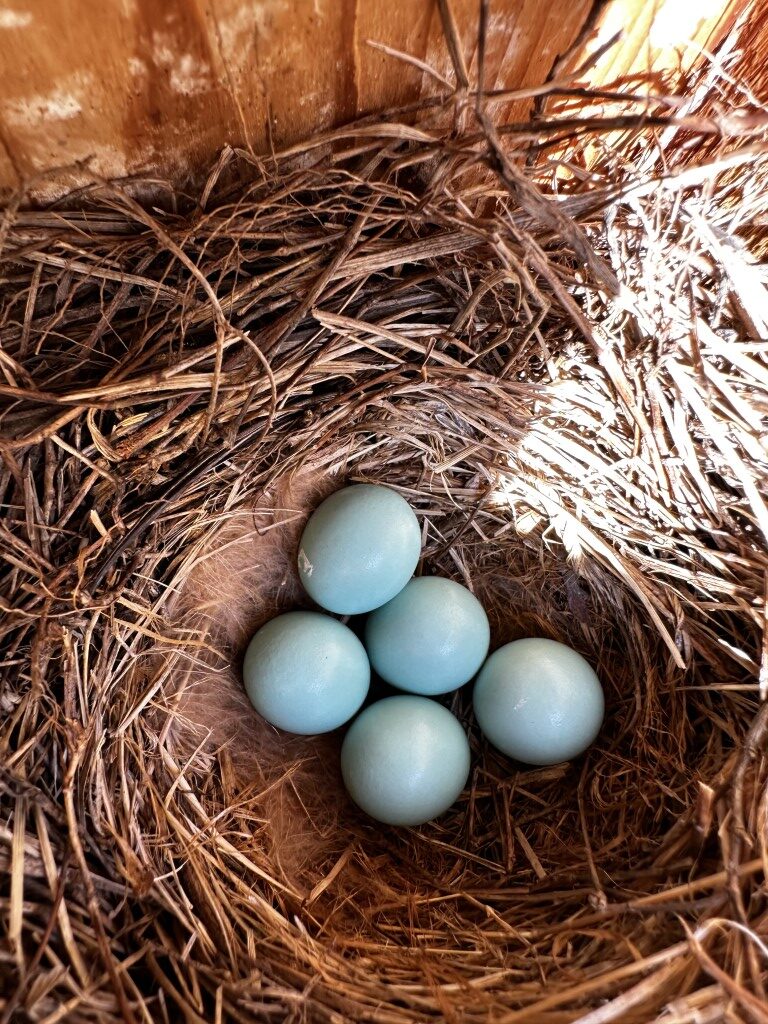
Clutch of bluebird eggs at CANS
In the Spring 2026 Songbird Station News, Bird Man Mel predicted May 20 for the second nesting in Mid-Missouri and June 29 as a third and final nesting. The concept of a “bluebird trail” originated in 1926 to encourage reproduction and survival rates of the bluebird population. The National Bluebird Trail was officially adapted in Missouri in 1945.
Cornell Lab of Ornithology reports from the North American Breeding Bird Survey that Eastern Bluebird populations increased between 1966 and 2019. Further, according to the International Union for Conservation of Nature (IUCN) Red List, the Eastern Bluebird is currently classified as “Least Concern.” The current population trend is identified as “increasing.” The Missouri Department of Conservation attributes the rescue of this species, in part, to the state-wide effort to create and monitor nestbox trails. The Missouri River Bird Observatory’s Bird of the Month: Eastern Bluebird article in March 2026 states that EABL’s use cavities made by other species, often woodpeckers, as well as artificial nestboxes with nestbox trails being “a practice that was imperative in rescuing the species.” The nestbox campaigns helped to offset the demand for nesting sites.
However, competition and predation (outdoor cats, snakes, racoons, etc.) as well as habitat loss continue to threaten the status of the EABL population. According to the National Wildlife Federation, threats are nest cavity competition with non-native birds, pesticide-driven insect declines, and habitat loss. Additionally, what helps is installing a properly designed bluebird nestbox, skipping lawn pesticides, and supporting the North American Bluebird Society network.
As partners in Eastern Bluebird conservation the City of Columbia Bonnie View Park (BV) and Columbia Audubon Nature Sanctuary (CANS) together provide a nestbox trail comprised of 14 nestboxes which are monitored weekly during the March through August nesting season by Boone’s Lick Master Naturalists–Kitty Peer, Leslie Palmer and Pat Smith.
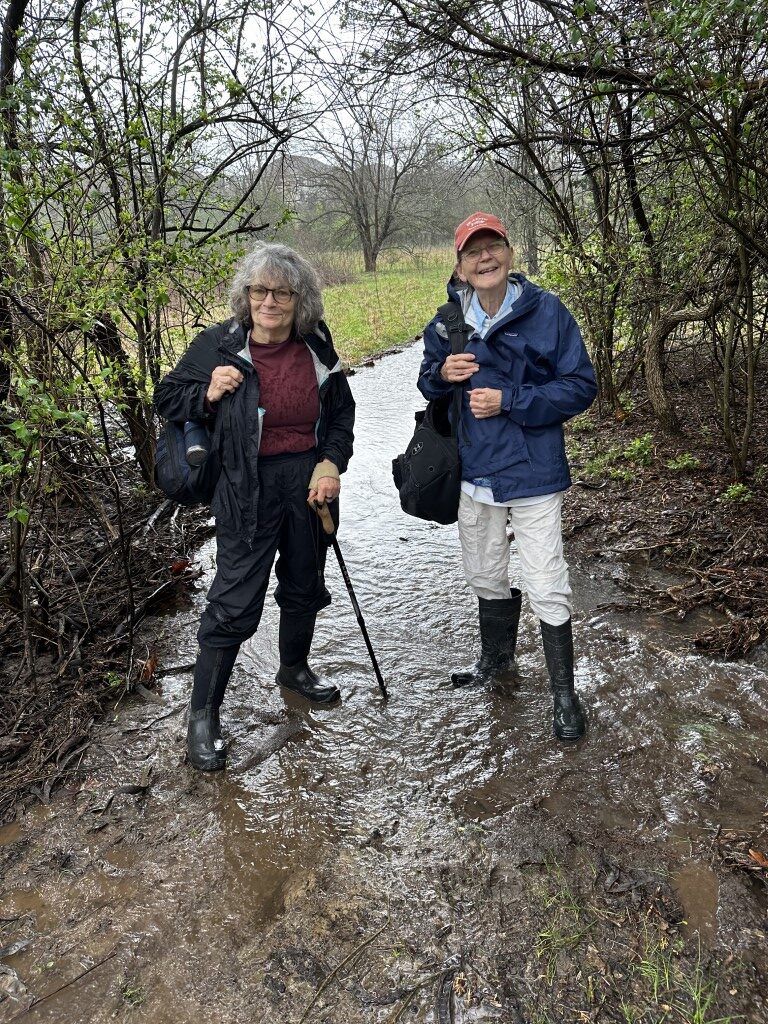
Despite the weather, this team monitors the boxes in the name of conservation.
Monitors assist with challenges, emergency response, and participate in habitat maintenance. Over the past six years, House Sparrows have pocked holes in the bluebird eggs, snakes have eaten the eggs out of the nest, dead babies and adult birds have had to be removed as well as non-viable eggs; also, nests and babies have been attacked by wasps and ants. Further, two weeks of below zero temperatures in 2021 brought ice and snow which sealed off the food source and lead to frozen bodies inside nestboxes. Unfortunately, one summer in August the adult birds disappeared (heat, pesticides and/or other attacks) leaving dead babies behind.
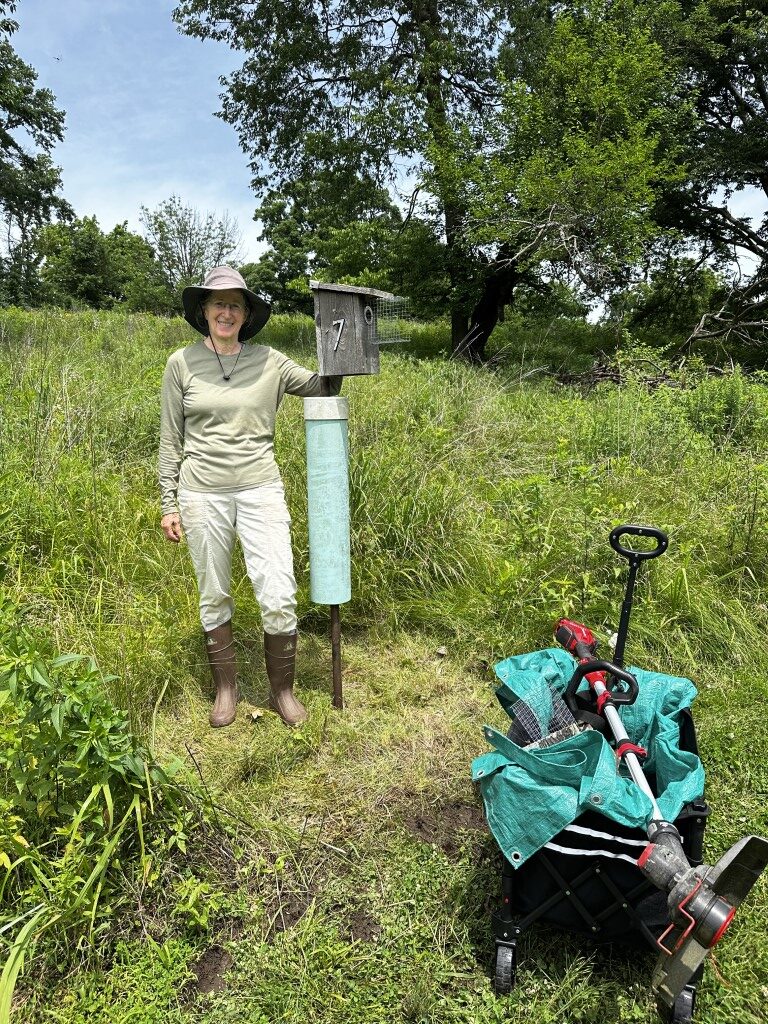
The EABL team successfully moved a nestbox at CANS recently and installed the Noel guard.
Kitty’s husband, Michael, has assisted this Master Naturalist team over the years by constructing new nestboxes and Noel guards as needed. Further, he helps move nestbox locations at CANS/BV. Over the years, one nestbox was replaced and three nestboxes attached to their respective posts were moved closer to the mowed area. Another worn out nestbox was replaced with a new box adding a Noel guard to protect against raccoons, cats and snakes; previous park insignia was removed and replaced. Finally, a nestbox attached to a post was moved this past 2026 season to a more favorable location. EABL’s prefer a site away from buildings and trees favoring a more open area. Many thanks to Michael Peer for his assistance.
The average number of fledges per year on the CANS/BV nestbox trail since 2017 is 37. In 2026, EABL’s attempted to nest 9 times and produced 40 eggs (all blue). The total number of chicks fledged was 39 due to one non-viable egg left in a nestbox. The season might be said to have been “fast and furious.” Habitat maintenance began on February 26; pieces of grass and partial nests began appearing on March 13. The first eggs were discovered on April 2. As the season progressed, eggs were laid quickly including two back-to-back EABL nests in the same box. The last fledge of the season occurred on July 23 rather than the end of August. Bluebirds were very scarce in the season of 2021 at CANS/BV nest box trail due to the Winter storms two years in a row and the severity and length of the cold spell. Since then, the nesting attempts and total number of chicks fledged has remained stable.
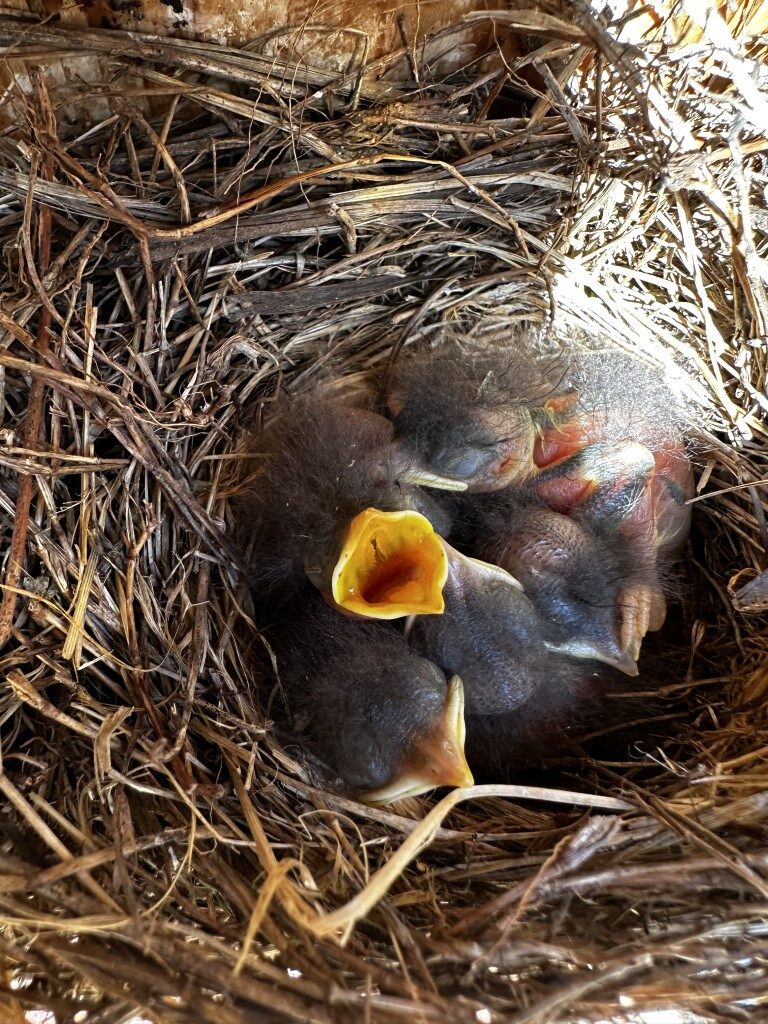
Hungry baby birds in the nestbox.
According to The Michigan Bluebird Society, due to habitat loss and the introduction of non-native species (House Sparrow and Starling), bluebirds have had a difficult time finding a natural place to nest. Bluebird nestboxes are especially made to give bluebirds a safe place to nest and raise their young. Bluebird boxes are said to be instrumental in the survival of the population. The loss of habitat continues with the non-native birds continuing to expand their breeding range. In summary, the most important factor in the recent Eastern Bluebird population recovery is said to be in volunteerism such as putting up and monitoring nest boxes, spreading the word and encouraging others to get involved.