CAS Dark Sky Efforts Underway
by Allison Vaughn
Last month, we mentioned that CAS has a Dark Sky Subcommittee and our primary efforts include securing Urban Night Sky Place certification for Rock Bridge Memorial SP and educating citizens about the importance of dark skies for wildlife, especially birds. We are pleased to announce that on February 26, we submitted a Preapplication for the certification of Rock Bridge Memorial to the Dark Sky International staff. We’re actually ahead of the game as we have partnered with a Missouri Master Naturalist, Jarrett Whitstance, who has been taking night sky quality readings for over a year now. We also have a Luxe Meter to read the measurements of light pollution from artificial lights at the park. So, we’re ahead of the curve but we still have a long way to go!
Hopefully many of you have attended Dr. Vayu Gokhale’s illuminating presentations on not only the importance of dark skies at night, but also small steps individuals can take to help prevent light pollution at home. Dr. Gokhale is a Physics professor at Truman State University (and really loves coming to Columbia) and was pleased to return to Columbia for a talk with CAS following his talk the previous year at the Missouri Bird Conservation Initiative Conference. Since Dr. Gokhale’s affiliate organization, DarkSky Missouri, has hit the ground running on educating the public of dark skies, DarkSky Missouri has been the recipient of two Community Conservation grants offered by MoBCI, which certainly highlights the importance of this issue in the birding community.
The CAS Dark Sky Subcommittee has reached out to the Office of Sustainability who regularly posts “Lights Out!” notices in the monthly city newsletter (included in electric bills) and on the OOS Facebook page, mainly during spring and fall migration. We have alerted the office of Dark Sky Awareness week, to be held April 13-20, and have encouraged them to run an article in the April newsletter. They seem receptive to the idea, so don’t toss that April newsletter in the recycling without reading it!
But what can individuals do to remove artificial light at night (a.k.a. ALAN)? If you’ve ever traveled to birding resorts in Arizona, especially in Portal and outside of Tucson (which is an official Dark Sky Community), you may have encountered the use of little nightlights in your cabin, warm bulbs for any outdoor lighting, and instruction to turn off the porch light. There are wonderful four packs of LED nightlights that are very affordable and energy efficient. We have used these for years to avoid having to leave a light on to see indoors at night, and I travel with one for hotel rooms. Conservation Chair Bill Mees made a big switch recently of changing his outdoor lights to warmer lights with lower lumens. This is a simple switch we can all make to outdoor lighting if it must stay on, though motion sensors are preferred, but warm lightbulbs are preferred for lower light pollution. The Mees’ have begun using the 5000K lightbulbs indoors and switched all of their outdoor lights to 2700K with no appreciable difference to human vision but a good deal for wildlife. Look on the label for anything lower than 3000K. Bill highlighted this information on his bulb box to share with you. For more Dark Sky resources and what YOU can do to promote dark skies at night, visit https://darkskymissouri.org/
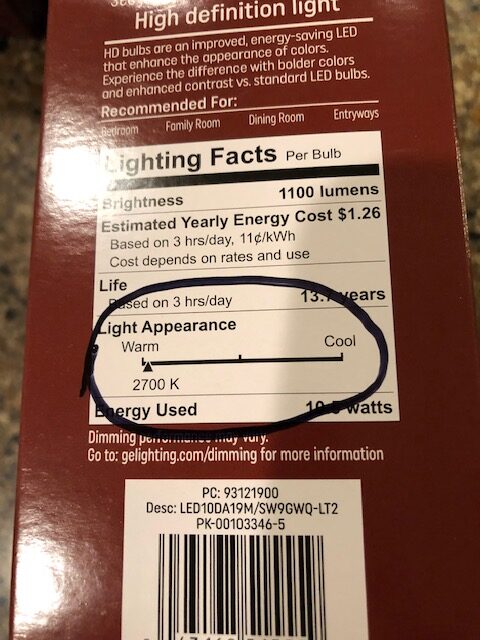
Look for this information on lightbulb boxes for outdoor lighting.
Look for this information on lightbulb boxes for outdoor lighting.